249. Henry Lewis | Breathing over hair

10 May - 13 June
Henry Lewis’ photograph is not so much a photograph of something as it is something constructed as a photograph. And while Henry is reluctant to discuss his process it’s easy to imagine his work being made on a computer in a program like photoshop where the limitations imposed by our physical reality don’t exist. In an interview about a previous body of work he said “I like the French word Bricolage which is the art of ‘do it yourself’, for me it is constructing an ephemeral piece from things that I find at hand and then, after photographic capture, its de-construction and demolition.” Here, as is the case with a great deal of art, the photograph doesn’t represent reality, it is a reality in its own right.
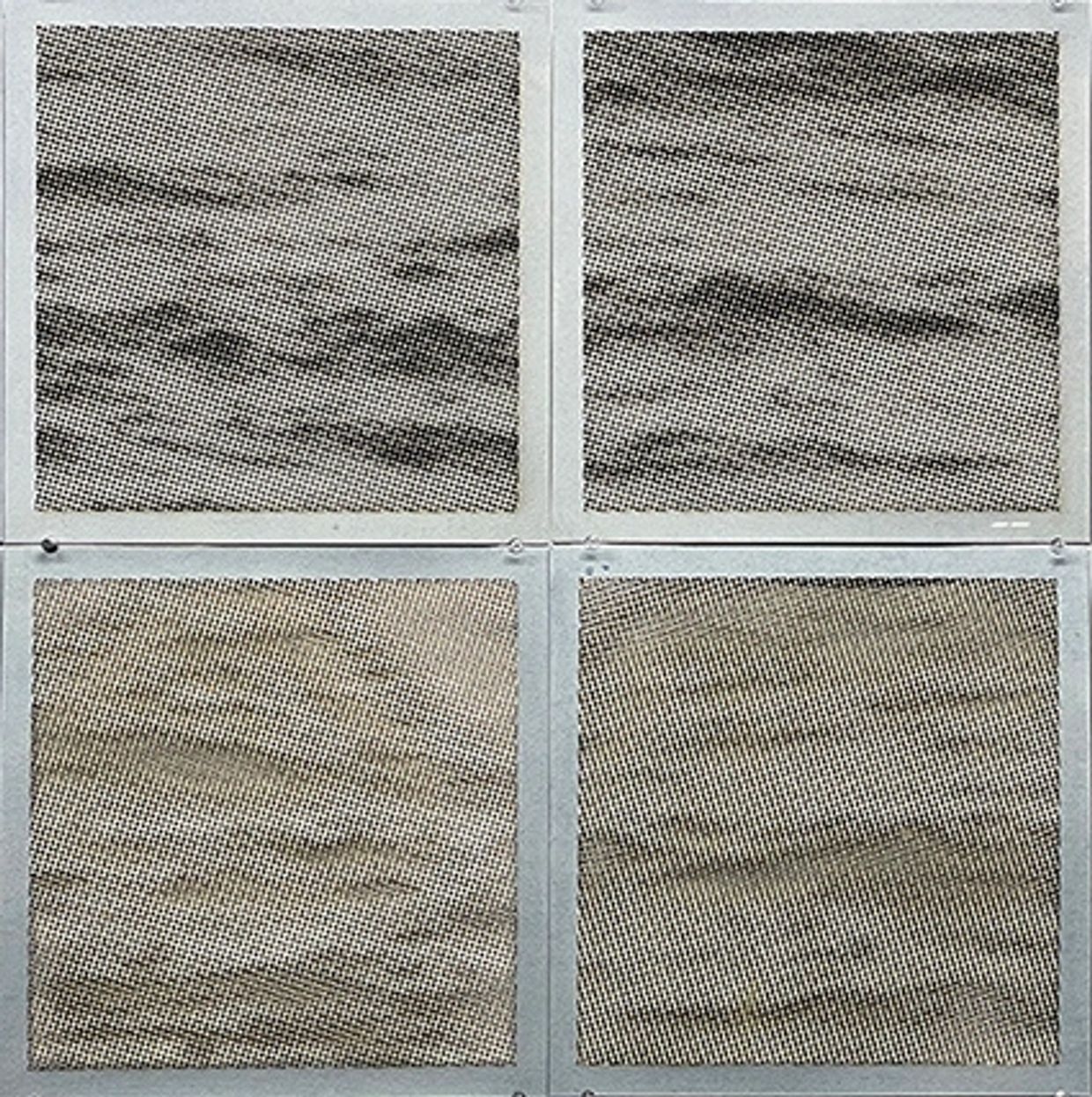
With this in mind the title of Henry’s work, Breathing over hair is surprisingly literal. They are photographs of hair here and over them, arranged in a sort of animated checkerboard, photographs of breath. More correctly they are photographs of the condensation within a breath, exhaled in a very cold place. Think of winter in France where Henry lived for many years or Bowral when he lives now. These are Henry’s breaths exhaled he said at about 14 times a minute, captured as a photograph before being given a “human” pink colouring and arranged in a manner that for me implies a pacing from one side of the picture to the next.


It’s hard not to think of there being a first breath that we understand to be accompanied by a cry and then a last breath that we hope is exhaled in silence. There might be the breath over hair in the passionate embrace of a lover or across the hair of another on our solitary rush hour train ride home. Here, as is the case with a great deal of art, literal meaning rests in an evocation of humanity, of breath and hair devoid of any instructive ideology or our pragmatic response to it.
Two similar works by Henry are included in an exhibition, Confluence at the Blue Mountains Cultural Centre, 26 April – 14 June. The catalogue essay observes, “There are 3 dimensions in Henry Lewis’ works. The first is the pictorial depth in which a single breath is represented…The second consists of the lines of surface composition in which each breath is set…the third is the rectangular shape also on the surface…One pictorial and two surface dimensions…an actual space and a map of breathing.” This is a constructed space as might be found in collage or bricolage or a contemporary digital version of it where the physical and conceptual constraints of reality do not apply. This reality is an invention.

250. Bernadette Ryan | Moving figures

14 June - 18 July
Bernadette Ryan is a teacher and a student. She completed a BA Fine Arts at Middlesex University in London, then a PG Diploma in Animation. Travelled to Sydney where she worked as a web designer and for the last 11 years, she has been a teacher with Studio Artes in Sydenham. But it’s her studies at the Tom Bass School of Sculpture in Erskineville that has given rise to this, Bernadette’s first exhibition.
While studying the figure as a sculptural subject Bernadette found herself considering the figure in motion. The model's movement from one pose to the next as opposed to the model's static pose that might usually be seen as the subject of sculpture.

Bernadette is not alone in choosing movement across time as the subject of art. It was an art movement called Futurism a century ago. In the media we are constantly watching time expand and contract. Some of us find a meditative space while walking. Others delight in mechanical transport from bicycles to sports cars where movement becomes an exotic delight, simultaneously necessary, dangerous and exhilarating - in a word, sexy.
It’s easy to think of these forms as figures, distorted by their movement through space and time. In time there was where they were, where they will be, and in a moment now. A meditative abstraction that is appropriate to SLOT where our audience is generally moving. Walking past, glancing at the window without breaking stride, passing in a car or on a bus or caught at the traffic lights, suspended in the hiatus of now, a moment that apparently lasts an entire lifetime.
251. Kendal Heyes | Turning tide

19 July - 22 August
Kendal Heyes came from New Zealand. He studied photography, painting, drawing and sculpture in Sydney until he competed a PhD. This work was previously exhibited in the Wollongong City Gallery and in line with his studies it bends a photograph through various digital drawing-like processes into a thin paper sculpture.
For this iteration of the work Kendal has imbedded the Palestinian flag in its sculptural fabric, and provided the title, Turning tide. Kendal feels that the tide of global opinion is changing on the conflict between Israel and the Palestinian people of Gaza and the West Bank. He comments, “to show the flag is to stand against the obliteration of Palestine by Israel.” Immediately the work asks for a moral judgment, then we might wonder, if global opinion can change as the tide does, is morality mutable? And of course it is, the shifting ground of cancel culture confirms it.
The presentation of political concerns as art confronts a harsh dichotomy. Is our appreciation of the art conditioned by our political views, or does art condition our political views? It’s easy to see the mood of propaganda coloured by art. Religious art has similar parameters although occasional it achieves a glorious evocation of humanity where questions of right and wrong are suspended. But can we suspend moral judgments in an evocation of humanity when our appreciation of art is dictated by our political views?
The reality of politics remains as does the devastation that engulfs the Palestinian people. Surely it is beyond questions of right, wrong, good and bad? Must it remain the consequence of contested colonisation that like the tide washing in and out repeats cycles of inalienable entitlement?
For most of us, when we stand gazing out on the shimmering ocean we face our origin. Like Kendal we came from somewhere else and like Kendal we must consider again a conflict, reflected in Australia by the inane rantings of Pauline Hanson against migration that belittles art, religion and humanity.

252. Match Box Projects | What we carry

23 AUGUST - 26 SEPTEMBER
This enigmatically sparse installation celebrates 20 years of the Match Box Project.
In 2006 when twin sisters, Leanne Shedlezki and Naomi Shedlezki decided to combine their interests in travel and art as a portable gallery project they chose the match as their totem. Since then, saying "They are all the same and they are all different", has become their motto.
For their project local artists were invited to make small works to fit inside bespoke clear perspex frames that were assembled in small bespoke clear perspex suitcases. These galleries made their way with the sisters from place to place, on the bus, through parks, stopping at coffee shops, bars and restaurants, where they became a foil in conversation. A conversation starter that inevitably lead to a discussion of art.

The project “became a portrait of the city in the hearts and minds of the city”, finding its audience in neglected corners of the community. The personal engagement inherent in the project saw their audience progressively become the project's artists. Conversations became workshops where non-artists were invited to compose installations in the trays of match boxes. The entire output of workshops, amalgamated as galleries housed in more bespoke clear perspex suitcases to travel on to further conversations that apparently randomly directed the project's journey. In all 4.5 thousand match box installations were made across 22 regions including Australia, Asia, Europe, North America, and the Pacific.
The project and its galleries have become a portal of record, documenting a voice of our world. What had been assembled as portable galleries was then presented as audio visual projections into emblematic suitcase frames. The suitcase next became a mirror. It traveled in a conversation that engaged communities momentarily in a time capsule. Each work finding a place in a series of random invitations and encounters.
Enigmatically, the match boxes and suitcases exhibited here are an echo of the project. An invitation to the future, to fill the suitcase, with what you might ask - your imagination, your story, or perhaps - your question?

253. Silke Raetze | Love bubbles

27 September - 31 October
There is a gentle whimsy to the title, Love bubbles.
For Silke these works are a response to breast cancer. A survivable disease requiring a debilitating treatment that left her with the desire to share something through art.
At 3 Silke immigrated with her parents to “the Shire”. They spoke German to each other but English to the children hoping they would grow up to be Australian. It worked, Silke studied commerce at Sydney Uni while painting in secret. Dropped out, to study Visual Communication at UTS, dropped out again. In London she bought an easel. There was a “coming out show” at Lindens Fine Art Gallery on Portobello Road. Back to Sydney, more shows then to the National Arts school as a student. From there 7 years working in a Sydney Gallery, another couple of shows, then, motherhood and its inevitable consequence, parenthood.

Silke's Australian life begs the question, why art? She feels that cancer drove her to look for something uplifting in art. She describes it as an offering, something left at the door of a lover, a love bubble. This then is a collection of such offerings that Silke may well have left at her own door.
Contemporary art is didactic, read as the story of the people who made it. They might be specific racial groupings, national or cultural identities that stand apart from the dominant culture. Perhaps tellingly our dominant culture is rarely represented as contemporary art, instead we observe a plethora of diversity.
In contrast Silke's offerings speak as devotional art. That is a kind of art that exists to take the artist's mind to another place. Objects, lovingly rendered as an expression of faith in something. The clear example is religious art where a particular image stands in place of the divine. In its rendering there is a path to the divine. Less clear are examples where the Divine is apparently absent, such as Silke's Love bubbles.
Through making this art, I sense Silke arriving at a contradictory place identified as tranquil and alert, personal and universal that might be a way of being alone.
